
Our Research
Without doubt, digital innovation is a game changer. Nations wrestle with the impact of automation and the disruptive potential of artificial intelligence, as existing models of business, employment, and human capital development are being fundamentally challenged. However, it should not be assumed that the Fourth Industrial Revolution (4IR) will generate increasing demand for skills and graduates, create better quality jobs, or enable shared prosperity. We focus our analysis on the future of work across these key questions:
- Will investments in education and training support jobs across both developed and developing economies that will meet the aspirations of today and tomorrow’s college graduates?
- Are there sustainable ways to facilitate the deployment of technologies to augment labour, and to fully capitalise on human potential?
- Which international examples show signs of promise or, better still, evidence that they work?
To properly address these questions, the Digital Futures of Work research programme brings together new conceptual approaches and research evidence for thinking about the future of work. Read Working Paper 01 for a detailed overview.
Key features of the research programme
|
|
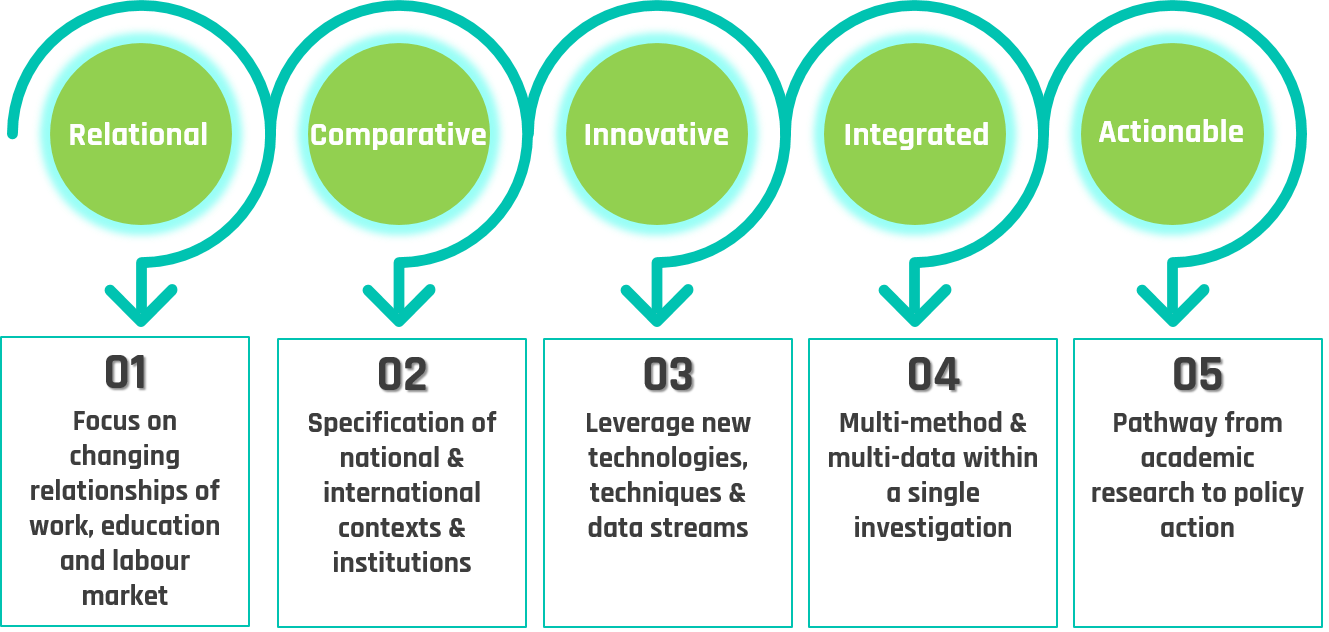
First, the research is aimed at overcoming a siloed approach where the focus is on either ‘supply’ (e.g. skills, education, training, lifelong learning), or ‘demand’ (job redesign, gig work, job vacancies). Studying the changing relationship between work and education, together with labour markets, is one of the things that distinguishes this research programme from other studies on the future of work. Indeed, it is getting this relationship right that will allow education and training to deliver on its role to build skills, and facilitate social mobility. We ask the hard question if indeed the future of work will meet the aspirations of a highly-skilled workforce across developed and developing economies, and under what conditions their aspirations will be met.
Second, the research builds in the specification of national and international contexts and institutions through the study of at least eight countries. This avoid the limitations of ‘technological determinism’ and the assumption that national economies will converge in the way work is organised and the workforce is trained. Previous periods of industrial transformation have shown us that technological innovation is non-linear. We live in an age of recombination as well as invention and digital technologies are a key enabler. Therefore, a distinct comparative approach will enable us to critically examine the key trends and policy reforms that provide the best prospects of delivering economic transformation for a better future of work.
Third, the research adopts new methodologies for investigating the future of work, by integrating a mix of methods and data streams, including ‘big data’. Notably, the research programme includes Burning Glass Technologies and AMPLYFI as its data partners, to contribute real-time labour market analytics and data-harvesting and visualisation solutions for a more responsive and comprehensive evidence base.
Fourth, our investigation is integrated, bringing together multiple methods and multiple data streams into a single investigation. We make use of survey data, case studies, big data and more. The process of constant triangulation is aimed at helping us develop a robust set of conclusions on the fourth industrial revolution.
Finally, we aim for our research to be actionable. Our analyses are theoretically-grounded and empirically-driven. They are designed to inform policy and public debate and enable societal actors to make careful assessments and take vital steps to directly shape the fourth industrial revolution towards human augmentation, social inclusion and a shared prosperity. We form networks with policymakers, corporate leaders, heads of education and training, unions, practitioners and more. Findings are released as they emerge. We will also periodically hold seminars and conferences to share our findings.
This research programme is possible with the funding support from SkillsFuture Singapore.